Want a more accurate number?
Plug-in energy monitors: useful when an estimate is not quite enough
For most people, a sensible appliance estimate is enough to get started. If you want to tighten the numbers, a plug-in meter or energy-monitoring smart plug can show what an appliance really uses.
Start with an estimate. Measure only when it helps.
PlugInSolarCheck is designed to give a useful answer from typical appliance values first. That is usually plenty for an early solar or power-station decision. Measure the real watts or kWh only when the result is close, the appliance varies a lot, or you simply want a more accurate figure.
Which type of energy monitor do you need?
Plug-in power meter
- Best for
- Checking one appliance at a time without an app
- Useful because
- Direct watts and kWh readings; easy to move between appliances
- Check before buying
- Check the exact UK plug, socket and load rating before use
Energy-monitoring smart plug
- Best for
- Longer-term logging, schedules and repeated appliance checks
- Useful because
- Can record usage over time and may add remote control
- Check before buying
- Energy monitoring varies by model; do not assume every smart plug measures power
Whole-home / CT-clamp monitor
- Best for
- Seeing household import or larger patterns rather than one plug-in appliance
- Useful because
- Useful for base-load and solar self-consumption analysis
- Check before buying
- Installation and interpretation are more involved; follow manufacturer instructions and use a competent electrician where required
Reviewed retailer options
If you do want to measure, start with a simple option
You do not need one of these to use the calculators. These are simply the first exact models where the retailer route and current manufacturer evidence line up with this job. Prices can change, so the buttons check the current Amazon UK listing rather than freezing a price here.
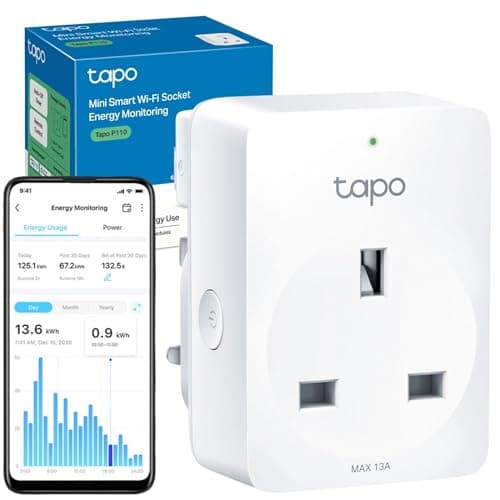
TP-Link Tapo
P110 Smart Plug with Energy Monitoring
Straightforward Wi-Fi option for measuring ordinary plug-in appliance energy use over time without adding a separate hub.
Manufacturer checks
- Energy monitoring is documented for this exact model.
- Maximum load: 13A / 2990W.
Important limits
- Use only within the manufacturer's documented load limits.
- Motor/compressor loads require extra care; TP-Link documents a 1/6 HP motor limit for this model.
- Treat the readings as consumer monitoring data, not a billing meter.
Product image and listing supplied by the Amazon Sellers Programme feed via Awin. Reviewed 2026-09-18; exact listing, price and availability may change.
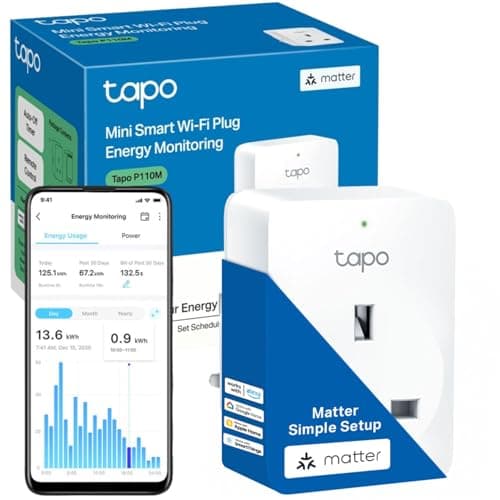
TP-Link Tapo
P110M Matter Smart Plug with Energy Monitoring
Matter-capable alternative when wider smart-home compatibility matters, while energy readings remain available in the Tapo app.
Manufacturer checks
- Energy monitoring is documented for this exact model.
- Maximum load: 13A.
- Matter certified; energy monitoring currently stays in the Tapo app.
Important limits
- Indoor use only and 13A maximum output.
- TP-Link explicitly states that EV charging is not supported.
- TP-Link advises against appliances with a motor/compressor higher than 1/6 HP.
- Energy monitoring is currently handled in the Tapo app rather than through Matter itself.
Product image and listing supplied by the Amazon Sellers Programme feed via Awin. Reviewed 2026-09-18; exact listing, price and availability may change.
What to look for in a plug-in meter
- A genuine UK Type G plug and socket from a reputable seller or manufacturer.
- A documented maximum load appropriate for the appliance you intend to measure.
- Real-time watts plus cumulative kWh, rather than voltage alone.
- A display you can read easily, or an app with useful historical energy data.
- Clear instructions and identifiable model information rather than vague marketplace specifications.
When not to use one
- Do not use a plug-in monitor for permanently wired equipment.
- Do not exceed the monitor's documented load or use it where the manufacturer excludes the appliance type.
- Do not treat a consumer monitor as a billing meter or proof of supplier metering accuracy.
- For consumer-unit work or fixed CT-monitor installation, follow the product instructions and use a competent electrician where required.
Use the number
Measured watts make the rest of PlugInSolarCheck more useful
Measure the appliance in the way you normally use it, note both the live power and the energy used over a representative period, then take those figures into the appliance or solar calculators. Motors, compressors and heating loads can behave differently from a simple steady wattage, so keep a sensible margin.
How product recommendations will be selected
PlugInSolarCheck may earn a commission from clearly labelled retailer links. A product will only be added here after the exact model, UK suitability, useful measurement features and retailer route have been reviewed. Amazon availability alone is not a recommendation, and a higher commission does not make a product more suitable.
The reviewed options above are deliberately narrow. Other marketplace candidates remain in the internal review queue until their exact model, manufacturer evidence and commercial route justify publication.
Read the affiliate disclosure