Source-led consumer guidance
Plug-in Solar UK 2026: current rules and what to buy
Plug-in solar is now legal in Great Britain, subject to the new product and installation requirements. It is a narrow solar-only route—not blanket approval for every 800 W kit.
Last checked 8 October 2026 against SI 2026/848, the current DESNZ plug-in solar outcome and launch guidance, Ofgem’s G98 decision and current exact-reference register evidence.
Launch-day legal update
Plug-in solar is now legal in Great Britain
Plug-in solar is now legal in Great Britain, subject to the new product and installation requirements. Only qualifying compliant solar-only products are covered.
Reviewed by George Brocklehurst — Electrical EngineerLast checked 8 October 2026
Legal, technical and product-evidence claims were rechecked against current DESNZ, legislation, Ofgem and exact-reference ENA evidence. How PlugInSolarCheck checks evidence and handles corrections.
Is the route in force?
Yes—in Great Britain since 27 August 2026.
Where does it apply?
England, Scotland and Wales. Northern Ireland follows a separate legal framework.
What is covered?
Complete qualifying solar-only devices meeting the final specification.
What should I buy?
Only a product with evidence for the exact UK model and supplied connection.
What changed on 27 August 2026?
- ✓ The regulations create a route for qualifying plug-in solar products to connect through a standard UK socket.
- ✓ The route applies to compliant solar-only devices meeting the final Interim Product Specification and other applicable requirements.
- ✓ Plug-in batteries and broader plug-connected generation remain outside this route.
- ✓ A loose collection of panels, microinverter, cable and plug is not automatically an approved device.
- ✓ Conventional hard-wired solar remains available through its existing installation route.
- ✓ A retailer listing, affiliate link, UK plug or European approval does not prove UK compliance.
Practical buying route
Which type of solar setup suits you?
Answer all five questions to see a route. Your answers stay in this browser and are not submitted.
Guidance for your situation
Use these focused guides to compare connection types, batteries, permissions and mounting before choosing a product.
Buying route A
Choose plug-in solar if…
You want to offset live daytime household demand, do not need battery storage, have an appropriate mounting position and can verify a complete UK product. Renters, leaseholders and flat owners should also check landlord, freeholder, planning and insurer requirements.
What it is good for
- • Daytime background loads
- • Routers, fridges and freezers
- • Standby equipment
- • Home-office electronics
- • Reducing grid import while appliances run
What it is not designed for
- • Power-cut backup
- • Supplying appliances when the grid is off
- • Storing surplus electricity
- • Feeding one isolated appliance
- • A plug-in household battery
- • Supplying large loads solely from a small array
Product-level evidence
Verified compliant systems
The exact UKSOL systems below retain direct evidence, and the Thunder Bolt 460W THUNE/21203/V1 and Bolt 920W THUNE/21204/V1 also have direct ENA Connect Direct records retained by PlugInSolarCheck. Other exact systems can be compliant when the current tracker lists them compliant; evidence provenance is shown separately and is not a different legal compliance tier. Availability is assessed separately. For the full current set, use the ENA reference checker.
The UKSOL and Solar Panels UK links in the cards below are ordinary retailer links. No affiliate or commission relationship is currently confirmed for either retailer.
Pro Compact 460W – Ground Mount
- Solar panels
- 460 W DC
- Maximum AC output
- 0.8 kW AC
Availability: Available now
Checked price: £599 from UKSOL direct on 8 October 2026. Prices and stock can change.
Ordinary retailer link · no commission relationship confirmed.
Pro Duo 890W – Ground Mount
- Solar panels
- 890 W DC
- Maximum AC output
- 0.8 kW AC
Availability: Available now
Checked price: £1,199 from Solar Panels UK on 8 October 2026. Prices and stock can change.
Ordinary retailer link · no commission relationship confirmed.
Pro Duo 890W – Hybrid Mount
- Solar panels
- 890 W DC
- Maximum AC output
- 0.8 kW AC
Availability: Coming soon
Pro Compact 515W – Hybrid Mount
- Solar panels
- 515 W DC
- Maximum AC output
- 0.8 kW AC
Availability: Coming soon
Pro Plus 1030W – Hybrid Mount
- Solar panels
- 1,030 W DC
- Maximum AC output
- 0.8 kW AC
Availability: Coming soon
Pro Max 1260W – Hybrid Mount
- Solar panels
- 1,260 W DC
- Maximum AC output
- 0.8 kW AC
Availability: Coming soon
Pro Advanced 920W – Hybrid Mount
- Solar panels
- 920 W DC
- Maximum AC output
- 0.8 kW AC
Availability: Coming soon
Direct partner offer · evidence kept separate
£20 off the ENA-confirmed Thunder Bolt kits
Use code PLUGSLR20. PlugInSolarCheck receives £40 per completed eligible Bolt purchase. That commercial relationship does not determine the ENA status or the ordering of evidence.
Thunder currently exposes the Bolt 460W through its plug-in-solar catalogue while the legacy bolt-400w product URL still describes a 400W kit, so PlugInSolarCheck deliberately does not label that legacy page as the 460W product. The Bolt 920W page uses a legacy bolt-900w slug but its live page content identifies the current 920W kit and exact ENA reference.
Do not need to connect to the house? Consider off-grid solar
Off-grid systems already power sheds, garden offices, workshops, camping equipment, caravans, allotments, CCTV, pond pumps, lighting and charging. They supply their own battery and outlets and do not export into household wiring.
Small off-grid setup
Lighting, router, phones and laptop
Medium off-grid setup
Garden office, fridge, television and several electronics
Larger off-grid setup
Longer runtime, larger batteries and selected workshop loads
Suggested shopping list only: separately chosen panels, controllers, batteries, inverters, protection, cables and mounting are not automatically compatible.
Documented off-grid products to compare
Compare only after calculating the required battery capacity, inverter output and panel input.
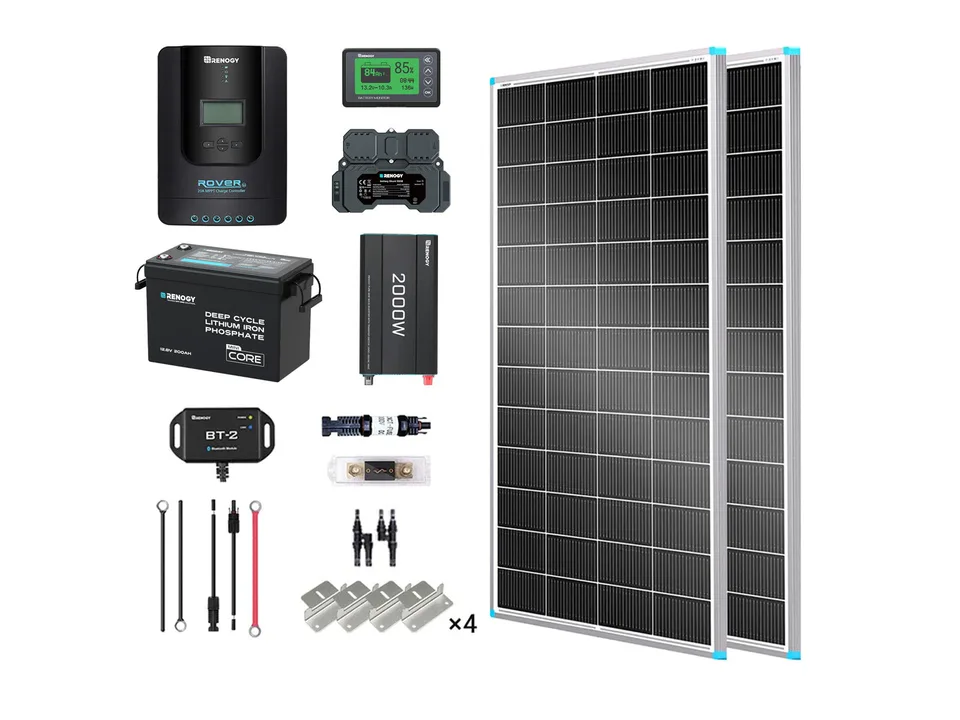
Renogy
2kWh 400W 12V Off-Grid Solar System
Best for: Larger independent solar setups
- Battery capacity: 2560 Wh
- Continuous output: 2000 W
- Surge output: 4000 W
- Maximum solar input: 400 W
Why this one / checks
A larger independent system after confirming every included component and the site design.
Product type: A larger off-grid system that still needs site-specific compatibility and installation checks.
Check before buying: Match the current manual to your calculator result, intended connections and compatible accessories.
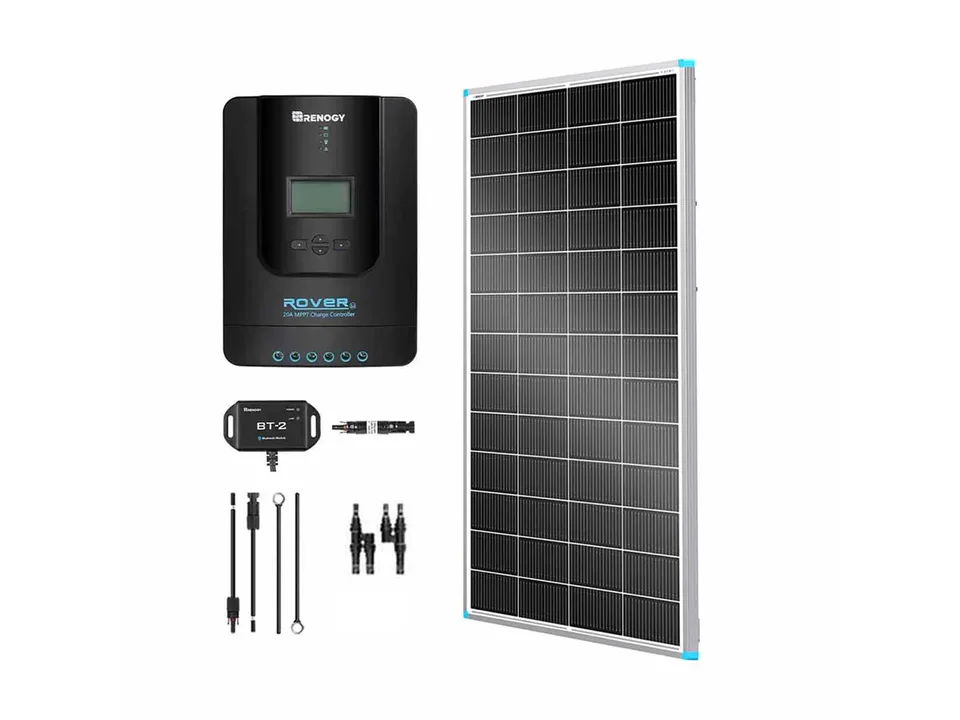
Renogy
200W 12V/24V Premium Solar Kit with Rover 20A Controller
Best for: Small off-grid battery systems
- Panel power: 200 W
- Charge controller: 20 A
Why this one / checks
A panel-and-controller starting point; battery, inverter, protection and installation remain separate.
Product type: An off-grid solar kit containing panels and charging equipment.
Check before buying: Match the current manual to your calculator result, intended connections and compatible accessories.
Want the easiest off-grid option? Choose a portable power station
An integrated battery, inverter and charging system can run compatible appliances from its own outlets. It can suit camping, occasional garden-office use, power cuts, routers, lights, televisions and some refrigeration—but never use it to energise household wiring through an ordinary socket.
Portable products with documented capacity and output
These are portable or off-grid products, not UK mains-connected plug-in solar.
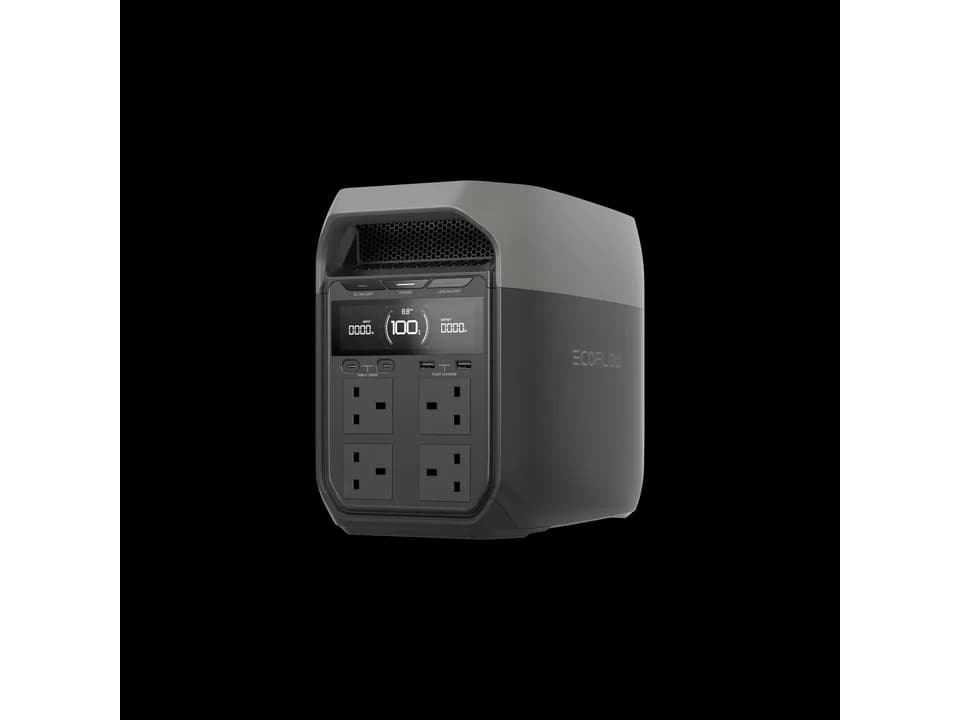
EcoFlow
DELTA 3 Series Portable Power Station
Best for: Daily office and medium loads
- Battery capacity: 1024 Wh
- Continuous output: 1800 W
- Surge output: 3600 W
- Maximum solar input: 500 W
Why this one / checks
Expandable portable loads after checking the exact selected model.
Product type: A portable power-station range with multiple capacity or expansion choices.
Check before buying: Match the current manual to your calculator result, intended connections and compatible accessories.
EFEUAFF55% off eligible EcoFlow products · ends 2027-01-01 · check the merchant page before buying.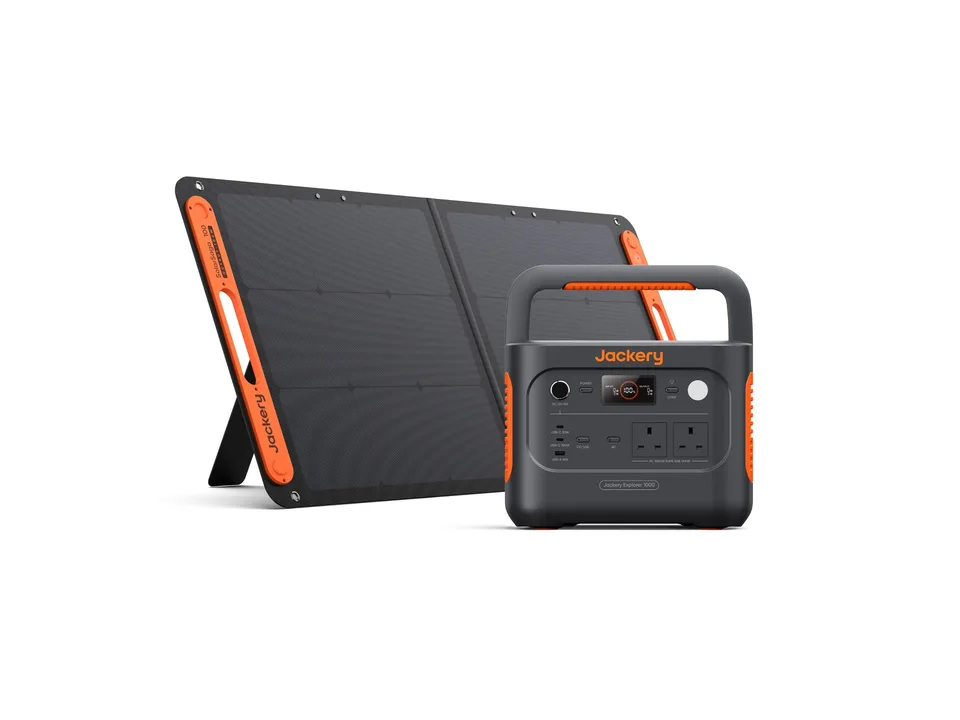
Jackery
Solar Generator 1000 v2
Best for: Daily office and medium loads
- Battery capacity: 1070 Wh
- Continuous output: 1500 W
- Surge output: 3000 W
- Maximum solar input: 400 W
Why this one / checks
A station-and-panel bundle for loads within its documented capacity and output.
Product type: A power station and solar-panel bundle sold together by the manufacturer.
Check before buying: Match the current manual to your calculator result, intended connections and compatible accessories.
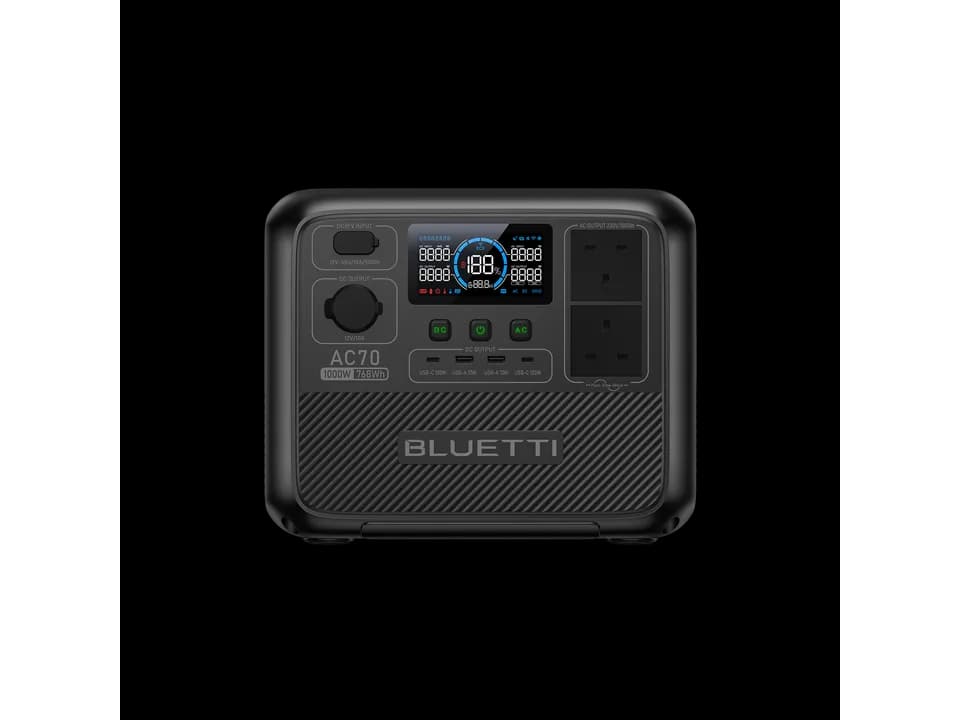
BLUETTI
AC70 Portable Power Station
Best for: Daily office and medium loads
- Battery capacity: 768 Wh
- Continuous output: 1000 W
- Surge output: 1500 W
- Maximum solar input: 500 W
Why this one / checks
Portable appliance power where its verified battery and inverter figures meet the calculation.
Product type: An integrated portable battery and inverter for compatible off-grid appliances.
Check before buying: Match the current manual to your calculator result, intended connections and compatible accessories.
What if I want a battery?
Plug-in batteries are not included in the new plug-in solar route. Portable power stations supply appliances from their own outlets; off-grid batteries belong to an independent system; fixed home batteries follow a separate professional installation route.
Portable power station
Best use: Temporary and portable appliance power
Connection: Own built-in outlets
Backup: Possible for selected loads
House wiring: Does not interact with household wiring
Off-grid battery system
Best use: Sheds, remote loads and designed independent systems
Connection: Dedicated off-grid inverter and outlets
Backup: Possible if designed for it
House wiring: Must remain separate from household wiring
Fixed home battery
Best use: Evening use, self-consumption and property-level backup
Connection: Professionally installed into the home system
Backup: Depends on the designed backup architecture
House wiring: Directly interacts with household wiring
Would conventional rooftop solar be better?
Installed rooftop solar is often the better route for owners with a suitable roof who want materially higher generation, export payments, long-term storage or a whole-home energy system.
| Feature | Plug-in solar | Portable station | Off-grid system | Installed rooftop |
|---|---|---|---|---|
| Household-wiring connection | Qualifying socket route | No | No | Yes |
| Battery compatibility | Outside current route | Integrated storage | Designed off-grid storage | Optional installed storage |
| Typical scale | Small | Small to medium | Small to larger | Larger home system |
| Power-cut operation | No | Selected loads | If designed for it | Only with designed backup |
| Professional installation | Product/site dependent | Normally no fixed work | Often for component/fixed work | Yes |
| Reduces daytime grid import | Yes | No | No | Yes |
| Powers isolated appliances | Not independently | Yes | Yes | Not its primary purpose |
| Renters | Potentially, with permissions | Often suitable | Site and permission dependent | Rarely |
Before you buy plug-in solar
Print this page if you want a paper checklist.
- Exact product intended for the UK market
- Exact model declares compliance with the final UK Interim Product Specification
- Appropriate ENA G98 Type Test Register evidence
- Solar-only product
- Approved UK plug and connection lead supplied by the manufacturer
- Complete installation and mounting arrangement specified
- No extension lead or multi-way adaptor use
- Socket and electrical installation are suitable
- Landlord or freeholder permission checked
- Planning, building and insurance requirements checked
- System matches daytime electricity demand
- Not a battery-integrated European product outside the current UK route
Questions buyers ask
Does every system below 800 VA qualify?
No. Maximum apparent output is only one condition. The exact complete product must satisfy the final Interim Product Specification and other applicable requirements.
Can a battery be part of the new plug-in route?
The route is for qualifying solar-only devices. Plug-in batteries and products designed to import electricity for storage are outside its scope.
Can I assemble my own panel, microinverter and lead?
A loose collection of compatible-looking components is not automatically a compliant plug-in solar device. The specification defines a manufacturer-supplied device including its connection line, plug and mounting system.
Will plug-in solar work during a power cut?
A grid-following plug-in solar device is not an off-grid or backup supply. It generally stops supplying when the grid is unavailable.
Official sources
Legal and product-safety claims on this page use current primary official material, including the government’s launch-day position.