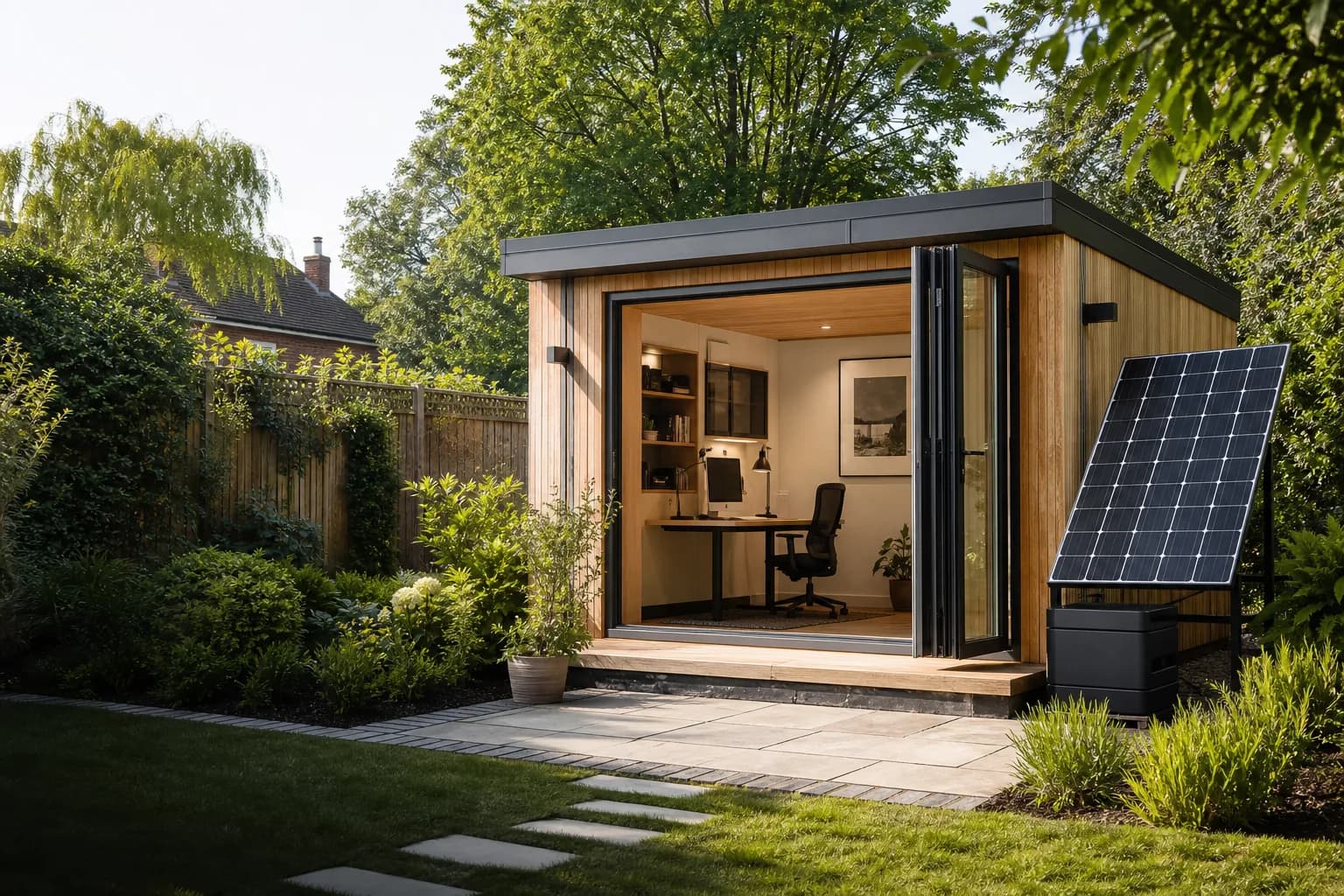
UK off-grid planning
Size solar for a shed or garden office
Estimate appliance energy, battery storage, seasonal panel capacity and inverter output for a shed, office, workshop, summer house or cabin.
Reviewed 24 July 2026 · Estimation tool, not an electrical design or site survey.
Free planning tool
Size an off-grid outbuilding system
Choose a starting setup, edit the appliance estimates and see how energy, battery, solar and inverter requirements change.
3. Edit selected loads
LED light
Laptop
Monitor
Wi-Fi router
Printer
Your estimate
A small off-grid kit or portable power station may suit these loads.
1. Nominal battery
1.01 kWh
2. Continuous inverter
250 W
3. Cautious year-round solar
930 W
Surge recommendation
250 W
Seasonal and energy detail
Summer solar
240 W
Spring–autumn solar
380 W
Daily / weekly use
536 Wh / 3.75 kWh
Favourable full-charge equivalent with the configured 400 W panel: about 2.4 peak-sun hours.
Suitable kit category
Small garden-office or portable setup
Compare usable battery energy, inverter output and solar-input limits against the estimate.
- Capacity requirement
- 1.01 kWh
- Output requirement
- 250 W continuous; 250 W surge
- Solar input check
- Must accept the planned array within its voltage, current and wattage limits
May not suit: Portable power stations are not permanently wired systems and must be used only through their intended outlets. Confirm every specification against your result.
How we calculated this
Formulas
- Appliance Wh/day = watts × hours × quantity × days/7.
- Adjusted demand = appliance Wh ÷ inverter efficiency ÷ retained energy after system losses × expansion allowance.
- Usable battery = adjusted demand × autonomy days.
- Nominal battery = usable battery ÷ usable-depth fraction.
- Solar watts = adjusted demand ÷ peak-sun hours × shade allowance × 15% design margin.
- Spring–autumn uses the midpoint of the selected summer and winter peak-sun assumptions.
- Inverter watts = all selected simultaneous watts × 20% margin × expansion allowance.
Current assumptions
- 90% inverter efficiency and 15% other losses.
- 80% usable battery depth and 1 autonomy day(s).
- 4 summer and 1 winter peak-sun hours.
- 15% future expansion; no shading allowance.
Selected appliance loads
- LED light: 32 Wh; 8 W if all quantities run together
- Laptop: 250 Wh; 50 W if all quantities run together
- Monitor: 150 Wh; 30 W if all quantities run together
- Wi-Fi router: 100 Wh; 10 W if all quantities run together
- Printer: 4 Wh; 50 W if all quantities run together
Shortlist equipment after calculating
The calculator can show a product only when the registry contains enough verified capacity and output data. Use this wider shortlist for manual comparison against your exact result.
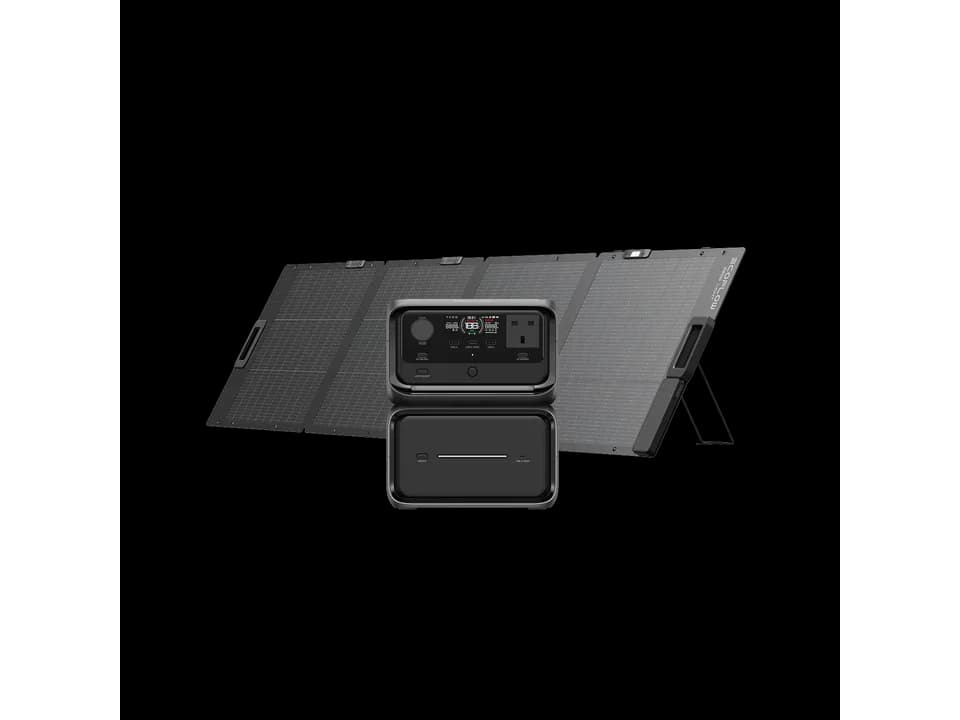
EcoFlow
RIVER 3 Plus Solar Generator with 60W panel
Best for: Phones, lights & small laptops
- Battery capacity: 286 Wh
- Continuous output: 600 W
- Surge output: 1200 W
- Maximum solar input: 220 W
Why this one / checks
Light outbuilding loads within its verified capacity and output.
Product type: A power station and solar-panel bundle sold together by the manufacturer.
Check before buying: Match the current manual to your calculator result, intended connections and compatible accessories.
EFEUAFF55% off eligible EcoFlow products · ends 2027-01-01 · check the merchant page before buying.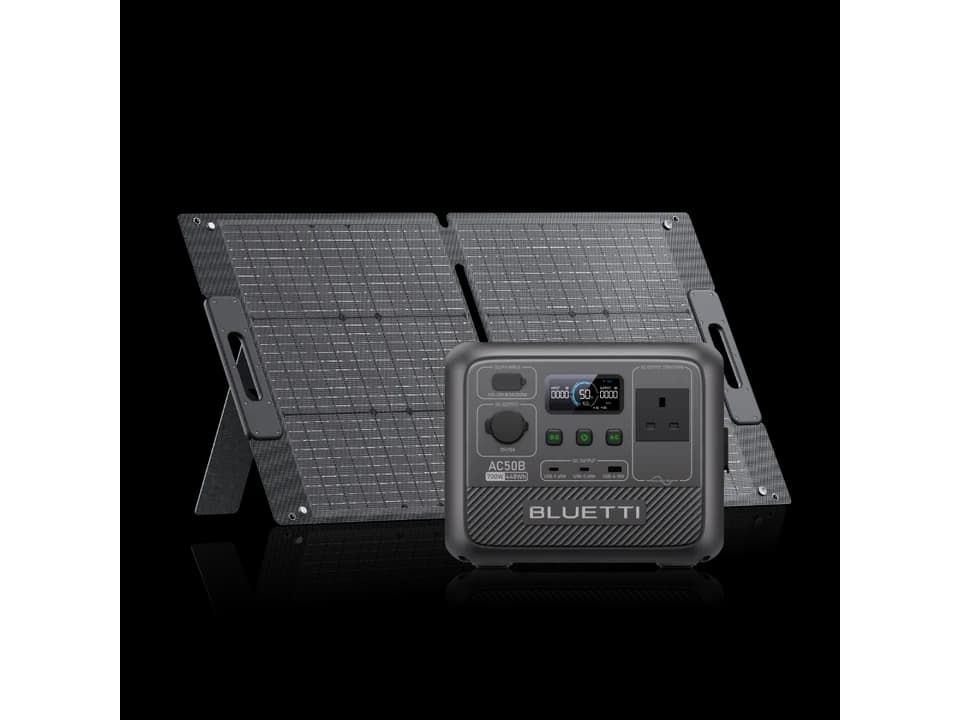
BLUETTI
AC50B with 100W Solar Panel
Best for: Light office and camping loads
- Battery capacity: 448 Wh
- Continuous output: 700 W
- Maximum solar input: 200 W
- Panel power: 100 W
Why this one / checks
A compact power station and panel bundle for modest shed loads.
Product type: A power station and solar-panel bundle sold together by the manufacturer.
Check before buying: Match the current manual to your calculator result, intended connections and compatible accessories.
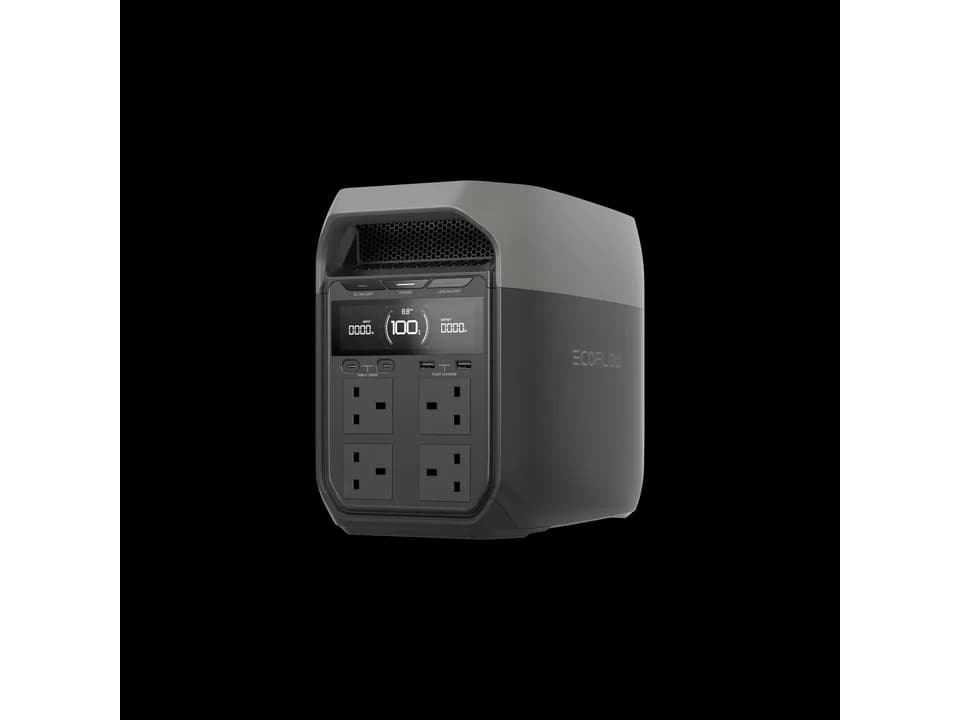
EcoFlow
DELTA 3 Series Portable Power Station
Best for: Daily office and medium loads
- Battery capacity: 1024 Wh
- Continuous output: 1800 W
- Surge output: 3600 W
- Maximum solar input: 500 W
Why this one / checks
Expandable portable capacity for a growing office setup.
Product type: A portable power-station range with multiple capacity or expansion choices.
Check before buying: Match the current manual to your calculator result, intended connections and compatible accessories.
EFEUAFF55% off eligible EcoFlow products · ends 2027-01-01 · check the merchant page before buying.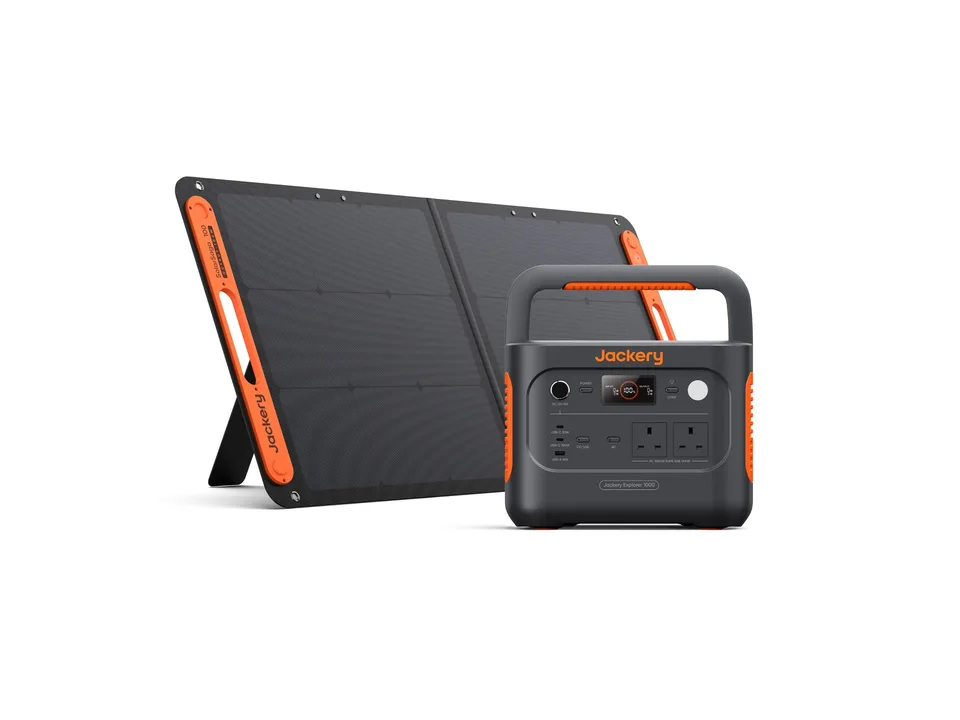
Jackery
Solar Generator 1000 v2
Best for: Daily office and medium loads
- Battery capacity: 1070 Wh
- Continuous output: 1500 W
- Surge output: 3000 W
- Maximum solar input: 400 W
Why this one / checks
A portable power station and solar-panel bundle.
Product type: A power station and solar-panel bundle sold together by the manufacturer.
Check before buying: Match the current manual to your calculator result, intended connections and compatible accessories.
What to take from the calculator when buying
- Choose nominal battery capacity at or above the result, allowing for the product's stated usable capacity.
- Check both continuous and surge output against appliances that may run together.
- Confirm the proposed panels stay inside the controller or station's voltage, current and wattage limits.
- Compare the cautious winter solar result, not only the summer figure.
- Use competent design for fixed wiring, protection, earthing and isolation.
Three worked examples
| Example | Assumed loads | Raw average daily energy | Main design issue |
|---|---|---|---|
| Basic shed | 8 W light × 4 h; 15 W phone charge × 2 h; 120 W tool charger × 1 h on 2 days/week | About 96 Wh/day averaged across the week | Low-sun reserve and secure panel position |
| Garden office | 50 W laptop × 7 h; 30 W monitor × 7 h; 10 W router × 10 h; 8 W light × 4 h; occasional printer | About 536 Wh/day averaged across the week | Reliable winter recharge and battery autonomy |
| Higher-demand outbuilding | 150 W computer; monitor; router; fridge; lighting; intermittent 500 W tool | Depends heavily on hours and days used | Motor surge, simultaneous watts and seasonal energy |
These are stated assumptions, not typical product specifications. Use appliance rating plates and realistic weekly usage in the tool.
Summer versus winter generation
Peak-sun hours convert variable solar energy into an equivalent number of hours at rated output. They are not literal hours of daylight. UK location, orientation, shade, weather, temperature and system limits all change real generation.
The cautious year-round result uses the winter assumption, so it can be several times the summer-focused panel estimate. Oversizing an array is not automatically valid: controller or power-station input voltage, current and wattage limits still apply.
Why electric heating changes the calculation
A 1,500 W heater used for two hours consumes 3,000 Wh before losses. That can exceed an efficient office's full daily energy several times over, while also requiring substantial inverter output. Heat demand is highest when winter solar is weakest.
The heavy-load comparison removes marked heaters, kettles, microwaves and larger tools so the impact is visible rather than hidden in a generic warning.
Portable power station or component system?
| Route | Advantages | Trade-offs |
|---|---|---|
| Portable power station | Integrated controls, portable, simpler manufacturer-supported interfaces | Fixed capacity and input limits; not for backfeeding or improvised fixed wiring |
| Component system | More configurable and potentially easier to expand or repair | Compatibility, protection and installation demand greater competence |
Common mistakes
- Confusing battery Wh with inverter W.
- Sizing only from panel wattage without calculating daily energy.
- Ignoring days per week, standby loads, winter and shading.
- Assuming every appliance runs independently when several may overlap.
- Connecting incompatible panels because the plugs appear to fit.
- Planning fixed wiring as though a portable station were a household supply.
Electrical and battery safety
- Use a competent person for fixed electrical installations and appropriate design.
- Never connect an improvised inverter or portable power station to household circuits or backfeed a socket.
- Earthing, overcurrent protection, cable sizing, isolation and RCD protection require proper consideration.
- Use portable power stations only within the manufacturer's load, charging, ventilation, temperature and moisture instructions.
- The calculator does not confirm building-regulation, electrical-regulation or product-specific compliance.
Frequently asked questions
How much solar does a garden office need?
It depends on daily watt-hours, simultaneous appliance watts, panel position and season. Efficient laptop, monitor, router and lighting loads need far less than electric heating or cooking.
What size battery does a shed need?
Calculate adjusted daily energy, multiply it by the desired autonomy days, then divide by the planned usable-depth fraction. Battery capacity and inverter output are separate requirements.
Can off-grid solar run an electric heater?
It can be engineered to do so, but resistance heating consumes a great deal of energy and is needed most during weak winter solar conditions. It can dominate battery, inverter and panel sizing.
Is a portable power station the same as plug-in solar?
No. A portable power station is an off-grid battery and inverter used through its intended outlets. It is not a grid-connected household plug-in solar installation.